

Osaretin Kayode Omoregie, Senior Fellow, Finance, Strategy & Performance, Lagos Business School
Introduction
During the period from 2022 – 2025, the revenue of a company tripled, increasing by approximately 209%, equivalent to a compound annual growth rate (CAGR) of about 46%. In the same period EBITDA grew by about 132%, EBIT, grew by 106%, the company remained profitable, paid dividend annually, and increased capital employed by about 130%.
Did this very impressive revenue growth create economic value?
Executive Reality Check
Executives and boards naturally pursue revenue growth because it signals market acceptance, competitive strength and potential increase in enterprise value. However, not all growth increases enterprise value. Growth creates value only when the return on invested capital (ROIC or ROCE) generated by the additional capital required to achieve the growth, exceeds the weighted average cost of capital (WACC).
A business can grow rapidly, report accounting profits, generate operating cash flows, pay dividends and still be destroying value.
Herein lies the paradox, the value illusion of revenue growth.
Why Does This Happen?
Because growth costs money.
Additional revenue requires additional investments in assets, working capital, people, production capacity, technology, and sometimes, acquisitions. The relevant question for executives and the board is thus how much capital was deployed to generate this additional revenue and what economic return was generated on this additional capital.
Revenue growth is not the same as value creation. This understanding changes the way we evaluate growth.
Two Hidden Culprits
Two factors can allow value destruction to remain hidden for years. These are structural operating inefficiency and capital structure misalignment.
- Structural operating inefficiency occurs when revenue grows faster than the economics of the business can support. Margins may deteriorate, operating costs may rise disproportionately, assets may be underutilised and working capital requirements may increase. The result is a business generating more revenue but progressively less economic return for each Naira of capital employed.
- Capital structure misalignment occurs when growth is financed in ways that undermines its economics. Increasing reliance on expensive or excessive debt can cause financing costs to absorb an increasing proportion of operating earnings. The business becomes larger while its financial structure becomes more fragile with hidden value destruction.
The Pursuit of Revenue Growth for Its Own Sake
Growth for its own sake is not an economically sustainable long-term strategy. There may be circumstances such as at startup, market entry or exceptional competitive pressure where management may deliberately accept lower returns in the short-term to achieve a strategic objective. But this should be an intentional strategic choice, not an assumption that growth is inherently valuable.
Three Questions Every Executive and Board Should Ask
When reviewing revenue growth, executives should ask a number of fundamental questions:
- Are our gross margins and EBIT margins improving, deteriorating or fluctuating? Revenue growth accompanied by declining or fluctuating margins requires management to distinguish temporary strategic effects from structural deterioration.
- Is financing cost consuming an increasing share of operating margins? If cost of debt is growing faster than the economic returns generated by the business, financial leverage may be masking unsustainable growth rather than supporting it.
- Is our return on capital comfortably above our cost of capital? If ROCE or ROIC is persistently below WACC, the company is destroying economic value over the period, despite reported accounting profit.
Executive and Board Dashboard
A useful executive dashboard should connect growth, margins, profitability, asset and capital efficiency and financing.
- Growth Quality: Compare Actual Growth Rate (AGR%) to Sustainable Growth Rate (SGR%). If AGR persistently exceeds the internal SGR, investigate how the gap is being financed and whether the financing structure remains economically sustainable.
- Return Spread (RS): Compare return on capital employed (ROCE or ROIC) with WACC. A positive spread indicates value is being created. A negative spread indicates value destruction. This is the underlying logic of economic value added (EVA).
ROIC% – WACC% = RS%; If RS% < 0 i.e. “Negative” è Value destruction.
The Fix
The fix for value-destroying growth is not to automatically slow down or stop growth but to fix its economics by closing the gap between AGR and SGR and reverse the negative spread between ROIC and WACC.
This will involve improving operating margins, profitability, asset utilisation, working capital management, retaining more earnings and operating cash flows by reducing dividend payout, restructuring debt, reducing expensive or inappropriate borrowing or raising more equity.
In extreme situations, it may require slowing growth and a fundamental rethink of the business strategy to bring operations, investments (in assets) and financing mix (debt / equity), in alignment.
The critical principle for executives and the board is not to attempt to grow its way out of a growth economics problem. If the underlying economics are deteriorating, more revenue will simply mask and exacerbate the problem.
A company can scale inefficiency just as easily as it can scale competitive advantage.
Executive Takeaway
Growth is an input to value creation, not value creation itself. The real test is whether each additional unit of growth generates returns that exceed the cost of capital required to produce it.
This is the difference between revenue growth as a performance statistic and growth as a value creation strategy.
When revenue grows, the CEO and board should ask, “What happened to our margins? How much additional capital did the growth consume? What did it cost us to grow?” And ultimately, “Did the growth create economic value, and not merely make the business bigger?”
The danger is not that a company grows too slowly. It is that it grows rapidly in the wrong direction and mistakes the resulting revenue and size increase for value increase, when in fact value is being destroyed.
This is the value illusion of revenue growth.
This article is the subject of a soon to be published executive technical note, case study and thought leadership series by the author, currently in development and use at Lagos Business School, Pan-Atlantic University.
Value Illusion Plc.
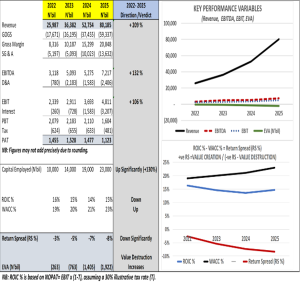
Verdict: Under current arrangements, the business is not merely destroying value every year, the annual economic value destruction is becoming larger as the revenue and capital base expands.