
Sixty-three years ago, the foundations of African unity were laid with a shared vision of collective progress. Today, as we commemorate Africa Day 2026 under the African Union’s Agenda 2063 theme “Assuring Sustainable Water Availability and Safe Sanitation Systems”, we are reminded that the “Africa We Want” cannot be built by policy papers alone. It must be forged through decisive executive action.
Across our continent, water security is under intense pressure from climate change, rapid urbanisation, and exponential population growth. But in Africa’s commercial epicentres, environmental issues do not live in silos.
Consider our cities: poor waste management and plastic pollution directly choke urban drainage systems. The result? Severe flooding, compromised water quality, and broken sanitation ecosystems. Not only is this an environmental hazard, it is also a direct threat to human capital, supply chains, and economic stability.
The LBS Stance: True leadership does not wait for a crisis to worsen. As Africa’s business school, Lagos Business School, Pan-Atlantic University (LBS) refuses to treat sustainability as a theoretical elective or a corporate social responsibility (CSR) footnote. Our mandate is to cultivate a new breed of African executives who see systemic continental challenges as urgent boardroom priorities. Our goal is not just to teach management excellence; we stress-test responsible leadership where it matters most: in the community.
From Classroom to Community: The Blueprint in Action
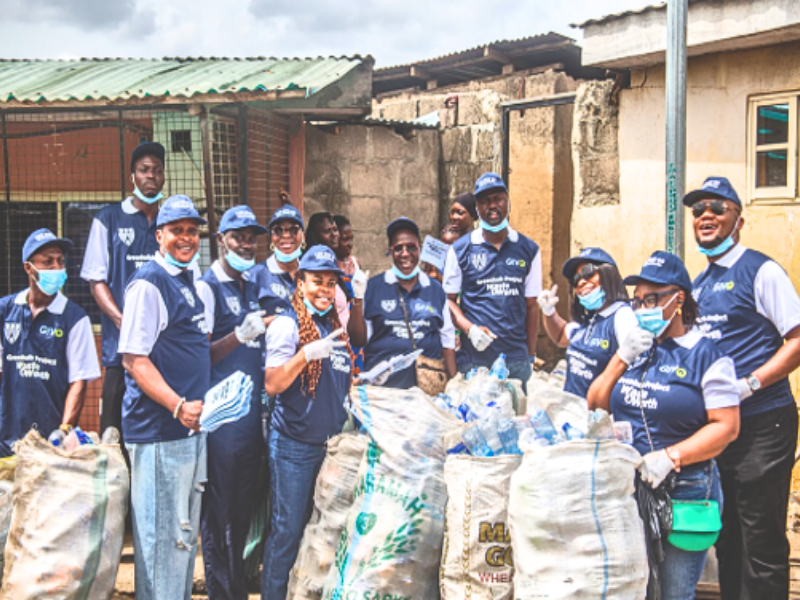
We believe that the true measure of business education is its localised impact. A recent Applied Impact Project by participants of the Senior Management Programme (SMP 99) perfectly embodies this ethos.
Recognising the toxic interplay between plastic waste, urban flooding, and sanitation failures, the SMP 99 cohort moved from analysis to action. Partnering with GIVO Africa, they launched a targeted, community-based intervention in the Ikota and Onigbongbo (Maryland) areas of Lagos.
This was not a passive academic exercise. The initiative deployed a rigorous, four-part framework:
- Community Education & Awareness: Aligning local stakeholders around environmental health.
- Behavioural Change Strategies: Designing practical incentives to drive consistent recycling habits.
- Structured Collection Infrastructure: Establishing data-backed plastic recovery systems.
- Impact Tracking: Using data-driven metrics to monitor environmental and economic recovery.
The results were clear and measurable: clogged drainage networks cleared, flood risks mitigated, and localised sanitation conditions rapidly improved.
A Nudge to Africa’s Business Leaders
Large-scale infrastructure investments and public policies are critical, but they are slow-moving gears. The ultimate success of Agenda 2063 depends on immediate, decentralised execution by individuals, organisations, and corporate leaders.
The SMP 99 initiative is a proof-of-concept. It proves that when African executives apply their strategic acumen to localised crises, systemic change happens. But one business school and a single cohort cannot transform a continent alone.
As we celebrate Africa Day 2026, Lagos Business School issues a direct challenge to our alumni network, business partners, and corporate leaders across the continent: What is your organisation doing to safeguard the ecosystem that sustains your market?
True leadership means taking radical responsibility for the footprint we leave behind. The blueprint exists. The urgency is undeniable. It is time to move from continental commitment to leadership in action.