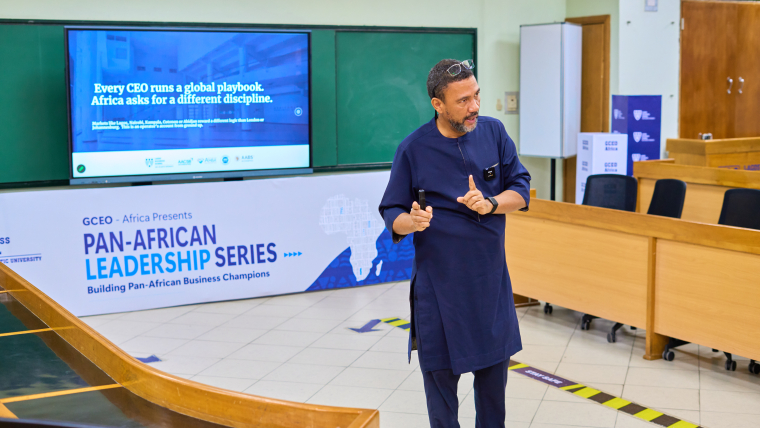

by Bongo Adi, Professor of Economics, Lagos Business School, Pan-Atlantic University
For the past 70 years, global economics has repeated a single gospel: poor countries get rich by building factories. The blueprint was simple – move workers from farms to assembly lines, leverage cheap labour, export manufactured goods, and climb the ladder to prosperity.
Today, that pathway is effectively closed.
We are witnessing a structural trap that economists call “premature deindustrialisation.” Automation and advanced artificial intelligence are rapidly stripping human labour from manufacturing before African nations can even gain a foothold on the industrial ladder.
When a machine in North Carolina can produce a garment at roughly the same cost as a worker in Bangladesh, the logic of outsourcing begins to collapse. The manufacturing route to prosperity has narrowed to near-impassability, even as Africa’s share of global manufacturing remains below 2%.
A Funeral or a Birth?
At first glance, this looks like a dead end. But this is not a funeral for Africa’s growth; it is a liberation from a borrowed map.
For decades, development economics treated progress as a fixed path: one where countries had to follow the West by industrialising step by step. African economies were expected to fit this model, even when their realities didn’t. That assumption is now breaking down. As it does, it creates space for Africa to chart its own path, one shaped by the realities of the AI era.
The Diagnosis: Why the Old Model Expired
The old economic model did not just fade away; it was overtaken by reality. Four major shifts have rendered the traditional blueprint obsolete:
- The Automation Trap: AI and robotics have drastically reduced the value of cheap labour. Manufacturing is no longer the mass-employment engine it once was.
- The “Copy-Paste” Error: For decades, “development” was treated as a rigid mandate to copy Western history, casting Western industrialisation as Africa’s only valid destination. This forced a diverse continent to fit its data into theories built elsewhere.
- The Reality on the Ground: Real African economies are already thriving in ways the textbooks completely fail to explain. High-growth sectors are bypassing the factory floor entirely. Nollywood and Fintech are cases in point.
- The Political Blindspot: Traditional models assume that elegant policies work in a vacuum. In reality, economic growth depends on how effectively a policy aligns with a nation’s actual institutional capacity. If an abstract framework ignores the real-world friction of local governance, it fails.
This reliance on outdated global templates has created a costly mismatch: local policies remain fixated on chasing vanishing factory jobs, while ignoring the sectors actually driving modern growth. Reclaiming economic sovereignty means building development strategies directly from these native, data-driven successes.
Consider where Africa’s true economic dynamism currently lies. Look at Nollywood, now the world’s second-largest film industry by volume, supporting roughly one million jobs. Look at the fintech ecosystem, which captured nearly half of Africa’s tech deals in 2024 and drives a digital economy that accounts for over 14% of Nigeria’s GDP. These “industries without smokestacks” grew without a single page of the traditional industrial-policy toolkit. They are not anomalies; they are the new baseline.
The Paradox of the Tech Elite
However, this transition introduces a profound paradox for Africa’s current market leaders, particularly in fintech and digital services. While milestones like mega-valuations and massive corporate acquisitions prove what African tech ecosystems can produce, their direct employment numbers remain remarkably modest. A sector can generate billions in value while only employing a few thousand elite engineers.
For the executives steering Africa’s digital giants, the old corporate playbook of building a proprietary, closed “moat” to lock out competitors is an existential dead end. If the digital economy remains an exclusive club that fails to create mass livelihoods, it becomes politically unsustainable. When extreme wealth concentration sits alongside mass youth unemployment, it triggers a predictable backlash: aggressive digital taxes, populist regulatory crackdowns, and a total loss of the tech sector’s social license to operate
True competitive advantage in the post-industrial era belongs to firms that stop thinking of themselves as isolated companies and start operating as network orchestrators. The challenge for modern business leaders is not simply how much value they can extract behind closed doors, but how effectively they can connect, coordinate, and scale interactions across the broader economy.
The Solution: A Manifesto for “Capability Orchestration”
If building physical factories is no longer the primary engine of growth, what replaces it? The core claim of this manifesto is that Africa must shift from a focus on mass production to a mastery of capability orchestration.
Instead of trying to pick winning industries, governments and business ecosystems must learn to connect, coordinate, and govern dense networks of people, technology, and institutions so that value can be created across multiple sectors at once. To make this a reality, we propose five core shifts:
- Build Ecosystems, Not Isolated Industries
We must move past the obsession with isolated sectors and instead build interconnected networks of skills, firms, universities, and regulators. To create mass employment, corporate and public leaders must intentionally broaden these networks by linking digital and financial capabilities to tangible, job-intensive sectors such as agriculture, logistics, and the creative arts.
- Deploy AI to Supercharge Workers, Not Replace Them
With 60% of Africa’s population under 25, the impact of automation is a critical policy choice, not a technological inevitability. While job exposure to automation is a real risk, Africa’s lack of locked-in legacy infrastructure gives it the unique freedom to adopt AI aggressively, provided we use regulation, public procurement, and private design to ensure AI automates tasks while augmenting human workers. We must actively guard against “algorithmic colonisation.”
- Trigger a Modern Services Revolution
Services – not manufacturing – must become the main driver of economic transformation. While no country has achieved sustained prosperity through services alone in the past, AI changes the equation by making services highly scalable and productive for the first time. The African Development Bank projects that inclusive, AI-enabled services could add up to $1 trillion to the continent’s GDP by 2035.
- Demand True Data Sovereignty
Data is the resource nationalism of the digital age; whoever controls the data controls the technology. Currently, our data architecture is highly extractive: foreign entities handle over 92% of local search traffic, build more than 70% of our 4G networks, and the entire continent holds just 1% of global data-centre capacity. True sovereignty requires building physical, domestic data infrastructure and technical capacity, not just passing legal frameworks.
- Re-engineer the University as an Economic Anchor
The African university cannot remain a passive importer of foreign textbooks. Higher education must be reimagined as a developmental anchor that produces original research, trains a specialised AI-era workforce, and invents economic paradigms tailored to African realities.
The Feasibility Check: Designing for Weak States
Elegant economic frameworks are meaningless if they cannot survive real-world politics; policy success depends entirely on the stability and openness of the political environment. For environments with weak state institutions, an ecosystem-based framework is uniquely resilient. Traditional industrial policy frequently fails because it requires centralised state bureaucracies to execute complex, top-down plans flawlessly.
Ecosystem orchestration, by contrast, distributes agency across universities, private firms, regulators, and diaspora networks. By shifting the burden away from a centralised state, it leverages distributed networks to drive growth.
The end of traditional development economics is not the end of development. It is the beginning of a harder, more profound task: building a framework for economic transformation without the comfort of a pre-mapped, 20th-century destination. It is time to step off the stalled escalator and orchestrate our own future.