
The barriers to trade are falling faster than the barriers to execution. What African business leaders must do about it.
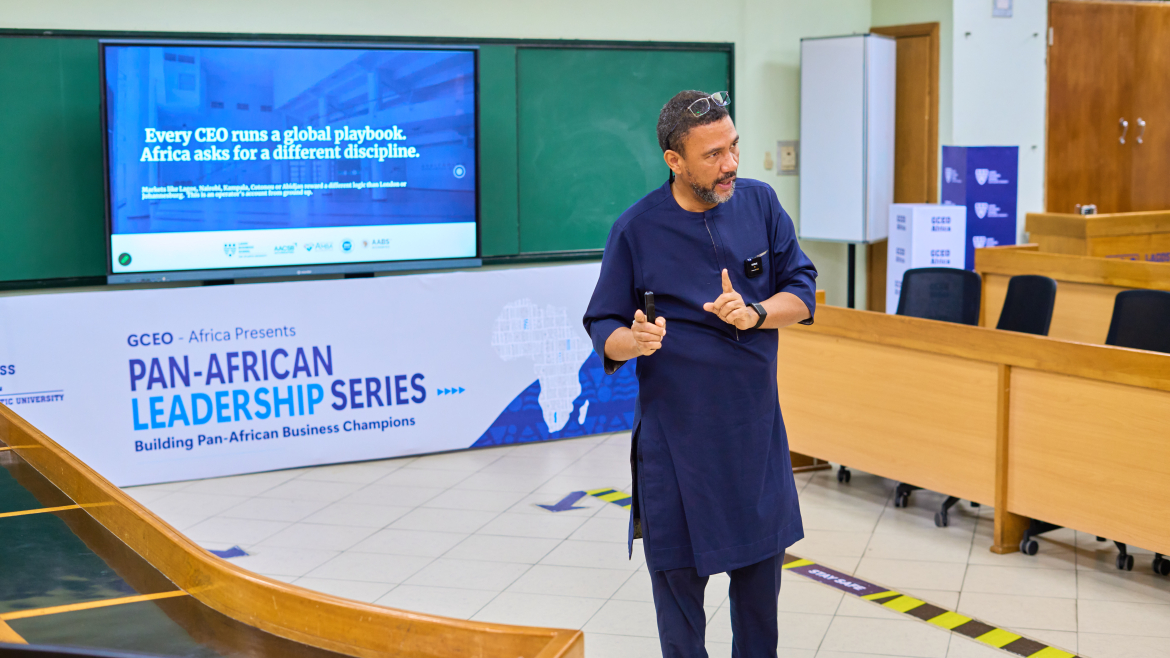
As African businesses look beyond their home markets for growth, the challenge is no longer whether opportunities exist across the continent, but whether their organisations have the capabilities to capture them. The African Continental Free Trade Area (AfCFTA) is lowering barriers to trade across Africa, yet many firms continue to struggle with the realities of cross-border execution. This paradox emerged as a recurring theme during the Lagos module of the 2026 Global CEO-Africa (GCEO-A) Programme, where participants examined what it means to move from viewing Africa as a collection of markets to treating it as a unified strategic platform for growth.
For many African businesses, expansion follows a familiar, yet often flawed pattern. A company establishes a strong position in its home market, achieves operational success, and then attempts to replicate that success elsewhere on the continent. It is usually at this point that momentum slows. Differences in regulation, infrastructure, consumer behaviour, market maturity, and talent dynamics create layers of complexity that make cross-border growth far more difficult than anticipated.
This challenge sits at the heart of one of the most important questions facing African business leaders today: How can organisations scale across Africa without losing focus, agility, or competitiveness?
The question featured prominently during the Lagos module of the 2026 Global CEO-Africa (GCEO-A) Programme, jointly delivered by Lagos Business School (LBS), Strathmore Business School, and China Europe International Business School (CEIBS). Bringing together senior executives from across the continent, the programme is designed to strengthen the strategic capabilities required to lead in increasingly interconnected markets. Its objectives align closely with the vision of the African Continental Free Trade Area (AfCFTA): enabling business leaders to identify, create, and capture opportunities that transcend national boundaries.
Across discussions on economic transformation, infrastructure, technology, entrepreneurship, governance, and market leadership, a common theme emerged: the next generation of African business champions will be built by leaders who stop viewing Africa merely as a geography and begin treating it as a strategy.
The AfCFTA Paradox
The promise of AfCFTA is compelling. By creating a single market spanning 54 countries, more than 1.4 billion people, and an estimated combined GDP of over $3.4 trillion, the agreement represents one of the most ambitious economic integration projects in the world.
Yet for many executives, the lived reality feels markedly different.
While policy integration is advancing, operational integration remains uneven. A manufacturer may benefit from reduced trade barriers but still face inefficient ports, fragmented logistics networks, and inconsistent customs processes. A technology company may discover demand across multiple markets but struggle with different regulatory requirements, payment systems, and data regimes. A retailer may find eager consumers beyond its home market yet encounter significant challenges in distribution, talent deployment, and execution.
This creates what might be called the AfCFTA Paradox: The barriers to trade are falling faster than the barriers to execution.
Historically, intra-African trade has lagged significantly behind other regions. While European and Asian economies have built deeply integrated regional markets, African businesses have often found it easier to trade with partners outside the continent than with neighbouring countries. Recent data, however, points to growing momentum, with intra-African trade continuing to expand as regional integration efforts, digital payment infrastructure, and logistics investments mature. Yet growth in trade volumes alone does not create competitive advantage.
The winners of the AfCFTA era will not simply be organisations that identify opportunities across borders. They will be organisations that build the capabilities required to capture them.
The Myth of Replication
One of the most persistent assumptions in African business is that regional expansion is simply a matter of replicating a successful domestic model.
In practice, expansion often exposes weaknesses that were hidden in a single-market environment.
Processes that worked efficiently at home become difficult to coordinate across several countries. Founder-led decision-making becomes unsustainable. Technology systems strain under regional demands. Governance frameworks built for one jurisdiction struggle in another. Organisational cultures become harder to maintain at scale.
This insight surfaced repeatedly throughout discussions during the Lagos module. The challenge is not market entry but organisational readiness. Whether examining infrastructure, digital transformation, governance, or market leadership, the recurring question was not where to expand, but how to build organisations capable of thriving once they do.
Beyond Borders: The Case for a Continental Mindset
For decades, businesses approached African expansion on a country-by-country basis. Each market represented a separate venture requiring new relationships, new systems, and often entirely different operating models.
While local adaptation is essential, a purely fragmented view of Africa increasingly limits growth.
Many of the continent’s most successful organisations have achieved scale by identifying connections between markets rather than focusing exclusively on their differences. Telecommunications networks operate across multiple countries. Digital payment platforms facilitate transactions across jurisdictions. Regional infrastructure projects connect producers and consumers across borders. Financial institutions increasingly build capabilities around continental value chains rather than national markets.
For today’s executives, the opportunity is not simply to enter additional markets but to design organisations that are built for cross-border growth from the outset. The implication is profound: Africa should no longer be viewed solely as a collection of markets to enter. It should be viewed as an interconnected set of opportunities to be shaped.
The Pan-African Growth Playbook
If Africa is a strategy rather than a geography, what capabilities must leaders develop to compete successfully? Discussions throughout the GCEO-A Lagos module pointed to four capabilities that increasingly distinguish regional winners from regional aspirants.
- Continental Vision
The starting point is a shift in mindset.
Leaders must move beyond national-market thinking and identify opportunities that cut across borders, sectors, and value chains. This means designing business models that create value across regions rather than within isolated markets.
A continental vision does not eliminate local realities. It simply allows leaders to see opportunities that others miss.
- Local Adaptation
One of the most important insights from discussions on market leadership, including perspectives shared by MTN Nigeria’s CEO Karl Toriola, was that scale and localisation are not opposing ideas.
Successful organisations maintain a common strategic vision while empowering local teams to adapt products, pricing, partnerships, and operating models to market realities.
The future belongs neither to rigid standardisation nor complete decentralisation, but to organisations capable of doing both.
- Institutional Capacity
Africa’s entrepreneurial energy is undeniable. Yet scaling beyond a single market requires capabilities that go beyond entrepreneurship.
Reflecting on the growth journey of companies such as Interswitch, participants repeatedly encountered an important lesson: successful regional businesses are built not only on innovation, but also on institutions.
Scaling across jurisdictions requires governance systems, compliance structures, leadership pipelines, operational discipline, and organisational cultures capable of absorbing complexity.
Businesses built around individual founders can win locally. Businesses built as institutions can win across the continent.
- Execution Discipline
If Africa has any shortage, it is rarely a shortage of ideas.
The continent is rich in ambition, innovation, and opportunity. What often separates successful organisations from unsuccessful ones is execution.
Building a regional enterprise requires leaders to navigate infrastructure challenges, regulatory complexity, talent constraints, and economic volatility over extended periods. Success depends not simply on strategic intent, but on disciplined implementation.
The Dangote Refinery offers a compelling illustration. Beyond its scale, the project demonstrates the importance of sustained execution in addressing structural constraints through long-term investment, operational discipline, and ecosystem development.
Across sectors, the organisations shaping Africa’s future are distinguished less by visionary ideas than by their ability to execute consistently in difficult environments.
Two Paths to Continental Scale
Not every organisation will scale in the same way. Indeed, two distinct approaches are emerging across the continent:
- The Vertical Integration Playbook
Large, well-capitalised organisations often manage market friction by internalising critical parts of their value chains. Dangote Group exemplifies this approach. Rather than waiting for ecosystem constraints to disappear, the organisation has invested heavily across production, logistics, energy, and distribution infrastructure.
Organisations following this path do not wait for the environment to become ideal; they design their business models to absorb predictable infrastructure deficits. It is a capital-intensive commitment to asset ownership to ensure operational reliability across borders.
2. The Ecosystem Integration Playbook
Most organisations, however, lack the capital resources required to build physical infrastructure at scale. For these firms, competitive advantage comes not from ownership but from connection.
Mid-sized and growth-stage enterprises increasingly leverage shared infrastructure such as regional payment platforms, tech-enabled logistics providers, digital marketplaces, and trade corridors. Platforms such as the Pan-African Payment and Settlement System (PAPSS) are reducing friction associated with cross-border transactions, while regional technology ecosystems are creating new opportunities to scale.
The objective in this case is not to build every capability internally, but to plug effectively into the capabilities already being built across the continent. Unlike vertically integrated businesses that build and control critical infrastructure, asset-light champions scale by owning a specialised niche and becoming indispensable partners within larger African business ecosystems. Their competitive advantage lies not in owning infrastructure, but in orchestrating it.
Interswitch offers a compelling example. Rather than owning banks, telecom networks, or retail outlets, the company built the digital rails that connect them. Its value lies in enabling transactions across institutions, industries, and markets, making it a critical part of Africa’s financial ecosystem.
From Firms to Ecosystems
A recurring theme throughout the programme’s Pan-African Leadership Series was the growing importance of ecosystems.
Historically, competitive advantage was viewed at the level of the individual firm. Increasingly, however, value is being created through networks of interconnected organisations.
Infrastructure enables trade. Digital payments facilitate commerce. Logistics links markets. Financial institutions support capital flows. Technology platforms reduce friction. Together, these systems create the conditions necessary for regional growth.
This reality is reflected in the work of organisations such as the Africa Finance Corporation (AFC), which invests in infrastructure that connects markets and supports industrialisation, and companies such as Interswitch, which facilitate economic activity across multiple jurisdictions.
For executives, the implication is clear: winning in an AfCFTA era may depend less on building isolated organisations and more on understanding how to participate in, shape, and leverage broader ecosystems.
Executive Self-Assessment: Is Your Organisation AfCFTA-Ready?
| Diagnostic Dimension | Assessment Question | Score (1-5) |
| Continental Vision | Are your product lines and supply chain nodes designed for regional hubs, or are you treating foreign expansion as a series of isolated export projects? | [ ] |
| Local Adaptation | Can your regional teams independently adjust pricing, distribution partnerships, and execution strategies without waiting for head-office approval? | [ ] |
| Institutional Capacity | Does your organisation have the governance, compliance, and digital systems required to navigate AfCFTA Rules of Origin and support cross-border transactions efficiently? | [ ] |
| Execution Discipline | Is your operating model resilient enough to maintain performance despite port delays, border friction, currency volatility, and infrastructure constraints? | [ ] |
Strong answers across all four dimensions are often what distinguish regional contenders from regional champions.
Scoring Guide
- Score 4-10: Informal Opportunist
Growth remains largely opportunistic and dependent on favourable market conditions. The organisation is vulnerable to operational, regulatory, and macroeconomic shocks and lacks the systems needed to consistently manage cross-border complexity.
- Score 11-15: Fragmented Exporter
The organisation has regional ambitions but lacks the institutional capabilities to scale efficiently. Expansion is possible, but weak systems, limited local empowerment, and inconsistent execution constrain sustainable growth.
- Score 16-20: Continental Champion
The organisation is built for regional scale. It combines strategic vision, local adaptability, institutional strength, and execution discipline, enabling it to leverage AfCFTA opportunities and compete effectively across multiple markets.
The Leadership Imperative for a More Connected Africa
The future of African business is often discussed in terms of demographics, technology, investment, and trade. These factors certainly matter. Yet they will not determine the continent’s trajectory on their own, without the right kind of leadership.
As businesses navigate an increasingly interconnected marketplace, Africa will require leaders capable of thinking beyond national borders, balancing local realities with continental ambitions, and building institutions that can scale across diverse operating environments.
This is why programmes such as the GCEO-A are becoming increasingly relevant. Beyond executive education, they provide a platform for senior leaders to engage with the strategic questions shaping Africa’s future, learn from organisations that have successfully navigated the complexities of regional growth, and develop the capabilities required to compete in a more integrated continent.
For African executives, the question is no longer whether opportunities exist across Africa. The question is whether their organisations are positioned to capture them.
And in that respect, perhaps the most important lesson from the Lagos module was a simple but profound one: Africa is not merely a geography to operate within. It is a strategy to be pursued.