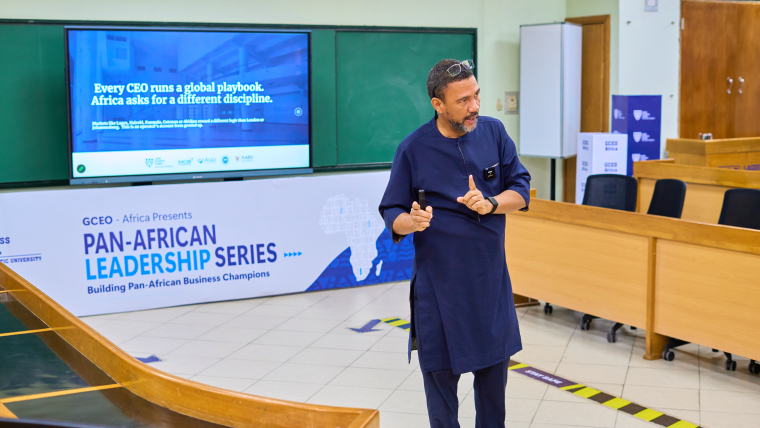
Olayode Agboola, PhD
Africa’s entrepreneurs have built their own risk-management systems. Formal businesses should pay attention.
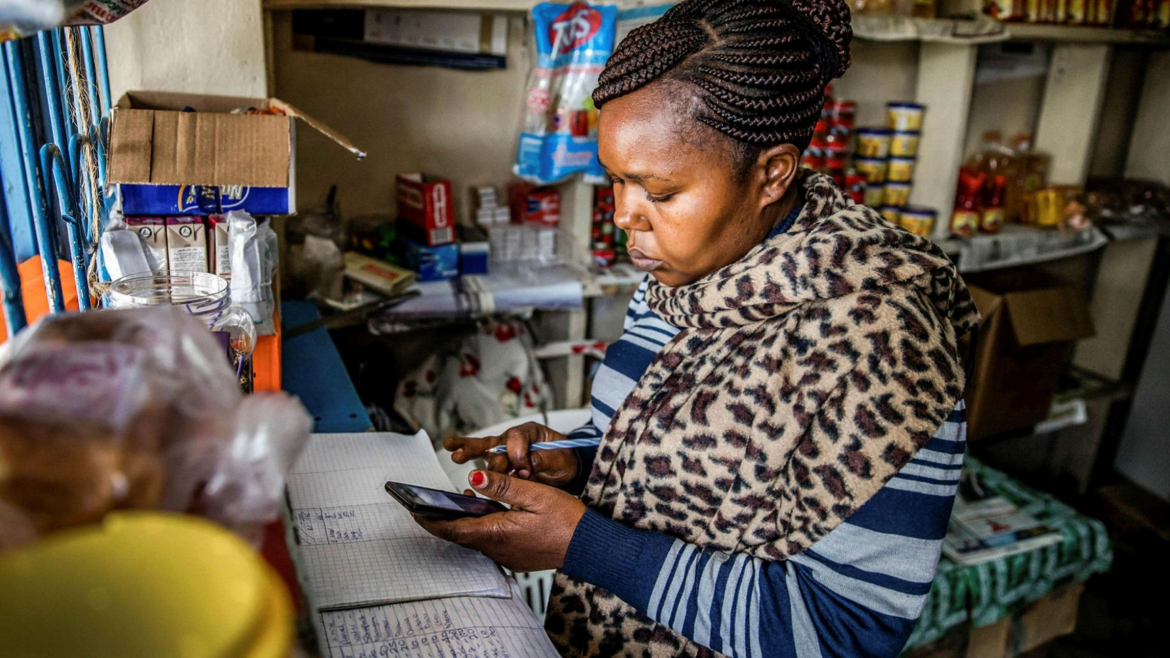
For years, Ifeoma Isietulugo (Obidum) walked between stalls in Lagos Island Market, collecting small cash deposits from vendors and recording each one in a paper ledger. Her business, Feedwell, builds on esusu, the age-old Nigerian thrift practice: vendors hand over a little money each day, and Feedwell keeps it safe until they need it. “People save little by little with me,” she told the Gates Foundation in 2025. “At the end, they use the money to buy what they need, or they collect it in cash.” Feedwell now employs 70 people and serves more than 10,000 customers on Lagos Island alone. In effect, it sells liquidity management to traders who will never have a treasury department.
The tools are different. There is no insurance policy, currency forward or credit line. Yet the logic is familiar: keep cash within reach, avoid depending on one source of income or supply, absorb shocks, and keep the ability to respond when conditions change.
The idea for this article came from a different corner of finance. In a 2025 study in the Journal of Applied Economics, my co-authors and I tested whether gold, silver, clean-energy stocks, Islamic stocks and real estate investment trusts protect investors against inflation, policy uncertainty, geopolitical tension and systemic financial risk. No single asset covered all four. Gold came closest, but it gave no cover against geopolitical risk, where clean-energy stocks did better. And most of the protection we found appeared in falling markets. A hedge, in short, is conditional.
That led me to a question closer to home: how do businesses that will never hold gold or a REIT protect themselves? In finance, a hedge is a position that gains when your main exposure loses. I use the word more loosely here, for any arrangement that limits how much a shock can hurt a business. The conditional logic carries over intact.
Risk management is usually taught through formal organisations, with their insurance, capital buffers and forecasting models. Millions of businesses in emerging markets have little access to any of these. Africa, for all its diversity, offers an unusually rich setting in which to see what they use instead.
THE CENTRAL IDEA
Informal businesses are not managing risk without tools; they are managing it with different ones. Pooled savings, diversification, trusted relationships and flexibility do much of the work that insurance and credit lines do in formal firms, and digital finance makes them cheaper to run. Each covers some risks and fails against others, above all shocks that hit everyone at once. The lesson for managers is to know which hedge covers which risk, and when it stops working.
Africa’s Informal Economy Is a Management Story
The scale of the informal economy makes this more than a development-sector curiosity. As of 2019, the International Labour Organization’s estimate puts informal employment at 84.3% of all employment in Africa. IMF researchers, measuring output rather than jobs, put the informal economy at almost 38% of GDP across sub-Saharan Africa. Most of the continent’s workers, in other words, rely on risk-management systems that sit outside conventional corporate finance.[1]
For a small shop, food stall, workshop or transport service, a shock that looks manageable on a corporate balance sheet can be existential. A rise in input prices eats the margin. A late customer payment creates a cash shortage. Illness takes the owner out of the business. Losing a trading location stops revenue overnight.
Formal firms respond with reserves, insurance, multiple suppliers, contracts and access to capital. Informal firms assemble protection from what is closer at hand. The result is not a formal risk-management system in miniature. The functions are much the same. The difference lies in the instruments, and in how promises are enforced: through repeated dealing and reputation rather than contracts and courts.
Four Principles of the Informal Hedge, and One Enabler
Diversification and flexibility work before a shock arrives. Pooling and relationships are built up in advance but drawn on mostly afterwards, to help an owner cope. Digital finance is not a fifth hedge; it is the infrastructure that makes the other four cheaper to run and easier to see.
1. Pooling: Build Liquidity Before It Is Needed
Across Africa, rotating savings groups let members contribute a fixed amount regularly and take turns receiving the pooled funds. They go by different names: ajo or esusu in parts of Nigeria, susu in Ghana, stokvels in South Africa. Alongside them sit daily deposit collectors such as Feedwell, who hold traders’ savings until they are needed.
[1] International Labour Organization (2023), Women and Men in the Informal Economy: A Statistical Update, ILO, Geneva (data mainly for 2019); Medina, L., Jonelis, A. and Cangul, M. (2017), IMF Working Paper WP/17/156 (unweighted average for 2010–14).
For a small business, a lump sum can finance inventory, equipment, an urgent expense or working capital. The group also creates discipline, because it depends on members paying in week after week. Economists who study these groups find that this commitment is much of the point: they are, first of all, a way to save.
The management principle is broader than the practice: liquidity is cheapest to build before a shock arrives. Formal organisations do this through reserves, credit facilities and mutual structures; shipowners have pooled their liability risks in mutual protection and indemnity clubs since the nineteenth century.
The limitation matters as much. A group with a fixed order of payouts helps with an unexpected shock only if members can swap turns, and no small pool can absorb a shock that hits all its members at once. Pooling works best when members’ risks are not closely correlated.
2. Diversification: Reduce Dependence on One Source
Many informal entrepreneurs spread risk by combining products, customers, locations or activities. A retailer carries several categories of goods; a household enterprise combines trading with farming or services; an operator keeps more than one supplier.
Concentration creates vulnerability, as any investment manager knows. Large manufacturers relearnt the point in 2021, when a shortage of chips, made by a small number of suppliers, halted car assembly lines across the world.
Diversification helps only when the extra activity offers a real alternative, though. Too many ventures consume scarce attention and capital. The useful question is not how diversified a business is, but which dependencies could stop it if they fail.
3. Relationships: Treat Trust as an Economic Asset
A supplier who lets a trusted customer pay after the goods have been sold is financing that customer’s working capital. Studies of trade credit, from Vietnam to sub-Saharan Africa, find that it rests largely on repeated dealing and reputation, because courts are slow, costly or out of reach. Reputation, in these markets, works as economic infrastructure.
Feedwell shows how. Vendors hand over part of their daily takings because years of reliable collection have earned their trust. “What makes my business bloom and grow every day,” Isietulugo told the Gates Foundation, “is that a lot of people have great trust in Feedwell.” Collectors like her are community enterprises in the missing middle between market and state, reaching traders whom banks and public programmes seldom reach. Business associations play a similar role.
Banks need not replace credit assessment with personal relationships. They can ask whether supplier relationships, transaction histories, association membership and payment behaviour can complement conventional measures of creditworthiness. Put simply, a record of reliability is information, whether or not it appears in the accounts.
4. Flexibility: Preserve Options
The least visible form of hedging may be operational flexibility. Small businesses often carry low fixed costs. They can change their product mix, switch suppliers, adjust working hours or move to where customers are. Judged by economies of scale alone, this looks inefficient. Under uncertainty it has value. Economists call it a real option: a business with fewer irreversible commitments has more choices when conditions change.
Large organisations face the opposite temptation, to optimise for efficiency until they have little room to adapt. The informal economy is a reminder that an option has value even when it is not being exercised today.
The Enabler: Make Resilience Cheaper and More Visible
In Kenya, the economists William Jack and Tavneet Suri found that households using M-Pesa, the mobile money service, absorbed income shocks without cutting consumption, while non-users had to cut back. M-Pesa did not invent a new form of insurance. It made an old one, money sent between relatives in hard times, cheaper and faster. In Nigeria, bank transfers, point-of-sale agents and payment apps do much of the same work, and each digital payment adds to a transaction history that a lender can read.
Isietulugo’s paper ledgers eventually became a liability. “Sometimes the records get torn or go missing,” she said, and a single error left her books out of line with her customers’ passbooks. The fix was Esusu Africa, a phone-based platform developed by AbdulAzeez Oguntoyinbo and his team with support from Lagos Business School’s Sustainable and Inclusive Digital Financial Services (SIDFS) Innovation Lab. By 2025, according to the Gates Foundation, it served more than 180 thrift institutions and over 500,000 customers, and had helped Nigerians save more than ₦100 billion (about US$70 million at the time). Isietulugo said the platform had taken Feedwell “from doing things manually to doing them digitally”.
Digitised, an informal savings practice becomes sturdier and more legible to formal finance. Legibility cuts both ways. A record a lender can read can also be read by a tax collector or a fraudster, and part of what makes informal arrangements work is their discretion. The principle is to make existing resilience cheaper and more visible without eroding the trust it rests on.
What Formal Risk Management Can Learn
None of this makes informal mechanisms better than formal ones. Insurance provides protection that a savings group cannot, and formal contracts offer protections that personal relationships cannot guarantee.
The deeper lesson is the one our study of financial hedges pointed to. Resilience rarely comes from one instrument. It comes from a portfolio of mechanisms, each matched to a particular risk and each with conditions under which it fails. Daryl Collins and her co-authors documented the same portfolio logic among poor households in Bangladesh, India and South Africa. Informal arrangements simply make the limits easier to see, because they fail in plain sight when a shock hits a whole market. Formal firms tend to discover the same correlations later, as 2008 and 2020 showed.
This is where the informal economy becomes useful to managers everywhere. Its practices raise questions that formal organisations can put to themselves:
| Informal mechanism | Underlying risk principle | Question for formal organisations |
| Pooling | Build liquidity in advance | Which exposures could we pool with peers before paying to transfer them? |
| Diversification | Reduce concentration | Which supplier, customer or market could stop us on its own? |
| Relationships | Treat reliability as information | What evidence of reliability do our credit and supplier models leave out? |
| Flexibility | Preserve options | Where have we optimised away our ability to adapt? |
| Digital finance (enabler) | Lower friction | Which of our buffers would work better if cheaper to run and easier to see? |
Designing Better Products for Informal Businesses
The same lens changes how institutions should serve informal enterprises. Banks and insurers can design around irregular cash flows rather than assume a salary or conventional collateral. Governments and development organisations can work through existing associations and savings groups instead of building parallel structures that entrepreneurs do not trust.
None of this means romanticising informality. Informal businesses can be excluded from legal protection, face theft and arbitrary enforcement, and remain highly exposed when shocks are widespread. Much informal work is also low in productivity, and few informal firms grow into formal ones. The aim is to identify which informal mechanisms are worth keeping and to strengthen them, without preserving the vulnerability around them.
The Limits of the Informal Hedge
Every hedge has a boundary, in a Lagos market as in a portfolio of gold and REITs.
A savings group may carry one member through a cash shortage but be overwhelmed when all members lose income at once. Supplier credit can bridge a timing problem; it cannot keep an unprofitable business alive. Diversification can spread a small entrepreneur too thin. Social networks can exclude outsiders and impose heavy obligations on members. Digital finance widens access without eliminating fraud, cyber risk or the consequences of a systemic shock.
These limits matter because resilience should not become another word for “coping”. Development economists distinguish between managing risk before a shock and coping with it afterwards, often by selling the very assets a household needs to recover. A business that survives each month by drawing down household resources is not necessarily resilient. The real test is whether a mechanism lets the enterprise absorb a shock without destroying the assets it needs for recovery.
The Bigger Management Lesson
Management thinking often starts with the formal organisation, because that is where data and financial instruments are easiest to observe. Uncertainty does not wait for a business to become formal before it arrives.
Few informal practices belong in a corporate policy manual. The principles underneath them do, along with a clear view of where each one stops working. The most resilient organisation may not be the one with the most sophisticated hedge, but the one that knows which risks each hedge covers and adapts before a shock becomes a crisis.
That is what the informal economy can teach formal business: risk management is not only about transferring risk. It is about designing an organisation that can keep moving when the future refuses to behave as expected.
Olayode Agboola is an economist on the faculty of Lagos Business School, Pan-Atlantic University, Lagos. Lagos Business School hosts the SIDFS Innovation Lab mentioned in this article.
Sources and Evidence Base
- Adediran, I.A., Oyadeyi, O.O., Agboola, O.W., Raji, K.H. and Ayoade, H.F. (2025), ‘Financial market risks and the hedging powers of unconventional assets under different conditions’, Journal of Applied Economics, 28(1), 2522129. https://doi.org/10.1080/15140326.2025.2522129
- Ambec, S. and Treich, N. (2007), ‘Roscas as financial agreements to cope with self-control problems’, Journal of Development Economics, 82(1), 120–137.
- Besley, T., Coate, S. and Loury, G. (1993), ‘The economics of rotating savings and credit associations’, American Economic Review, 83(4), 792–810.
- Collins, D., Morduch, J., Rutherford, S. and Ruthven, O. (2009), Portfolios of the Poor: How the World’s Poor Live on $2 a Day, Princeton University Press.
- Dercon, S. (2002), ‘Income risk, coping strategies, and safety nets’, World Bank Research Observer, 17(2), 141–166.
- Dixit, A.K. and Pindyck, R.S. (1994), Investment under Uncertainty, Princeton University Press.
- Fafchamps, M. (2004), Market Institutions in Sub-Saharan Africa: Theory and Evidence, MIT Press.
- Gates Foundation (n.d., c. 2025), ‘The digital finance fix helping Nigeria’s market vendors grow their businesses’, https://www.gatesfoundation.org/ideas/articles/digital-finance-nigeria-market-sellers (accessed 5 October 2026). Source of the Feedwell and Esusu Africa figures and of all quotations from Ifeoma Isietulugo.
- International Labour Organization (2023), Women and Men in the Informal Economy: A Statistical Update, ILO, Geneva.
- Jack, W. and Suri, T. (2014), ‘Risk sharing and transactions costs: evidence from Kenya’s mobile money revolution’, American Economic Review, 104(1), 183–223.
- La Porta, R. and Shleifer, A. (2014), ‘Informality and development’, Journal of Economic Perspectives, 28(3), 109–126.
- McMillan, J. and Woodruff, C. (1999), ‘Interfirm relationships and informal credit in Vietnam’, Quarterly Journal of Economics, 114(4), 1285–1320.
- Medina, L., Jonelis, A. and Cangul, M. (2017), ‘The informal economy in sub-Saharan Africa: size and determinants’, IMF Working Paper WP/17/156, International Monetary Fund.
- Morduch, J. (1995), ‘Income smoothing and consumption smoothing’, Journal of Economic Perspectives, 9(3), 103–114.
- Rutherford, S. (2000), The Poor and Their Money, Oxford University Press.
- Scott, J.C. (1998), Seeing Like a State, Yale University Press.
[1] International Labour Organization (2023), Women and Men in the Informal Economy: A Statistical Update, ILO, Geneva (data mainly for 2019); Medina, L., Jonelis, A. and Cangul, M. (2017), IMF Working Paper WP/17/156 (unweighted average for 2010–14).