Nigeria’s transition to a more sustainable and inclusive economy will require more than ambition. It will require significant investment, supportive policies and coordinated action across sectors.
With an estimated annual climate financing gap of approximately US$27.2 billion, one of the most pressing questions facing the country’s climate and development agenda is how the capital required for a just transition can be mobilised, aligned and deployed at the scale needed to deliver meaningful impact.
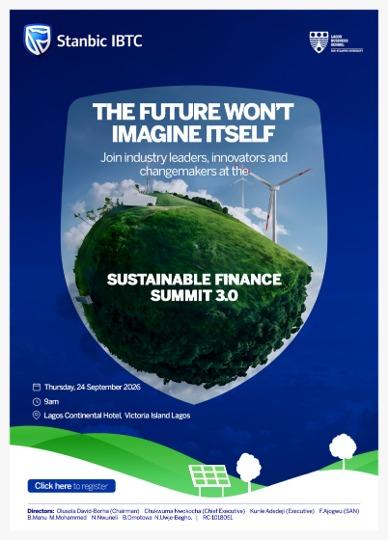
It is the question that will sit at the heart of the third edition of the Stanbic IBTC Sustainable Finance Summit (SFS 3.0), which will be convened by Stanbic IBTC Holdings in collaboration with the Lagos Business School Sustainability Centre (LBSSC) on Thursday, September 24, 2026, at the Lagos Continental Hotel.
Under the theme, “Financing Nigeria’s Just Transition: Mobilising Capital for People, Policy and Prosperity,” the summit will bring together leaders from government, financial services, business, development finance institutions, industry, academia and the investment community to explore practical pathways for financing sustainable growth.
From Climate Ambition to Investable Opportunities
As the realities of climate change increasingly intersect with economic development priorities, the challenge is no longer simply setting sustainability goals. The focus is shifting towards execution: how to channel capital towards projects and initiatives capable of delivering both environmental and socioeconomic value.
For Chuma Nwokocha, Chief Executive Officer of Stanbic IBTC Holdings, this is the central challenge the summit seeks to address.
“Nigeria’s climate and development agenda is at a critical juncture, given the annual climate financing gap of approximately 27.2 billion USD. The question before us is how we finance a transition at the scale and speed required to connect capital with real opportunities in the economy that will promote green investments, enable climate-resilient infrastructure, and support livelihoods. SFS 3.0 provides the platform to mobilise the multi-sector stakeholders and the capital required to translate Nigeria’s just transition ambitions into investable opportunities, economic activity and measurable impact.”
The summit is designed to move the conversation beyond broad commitments and towards practical solutions, examining how financing mechanisms, investment frameworks and partnerships can help accelerate Nigeria’s transition while creating economic opportunity.
Unlocking Domestic Capital for Sustainable Growth
A key focus of the summit will be the role domestic capital can play in supporting Nigeria’s sustainability ambitions.
The summit will feature a keynote address by Titilayo Oshodi, Special Adviser to the Lagos State Governor on Climate Change and Circular Economy, titled “Capital Meets Climate: Financing Nigeria’s Just Transition at Scale.”
The conversation will continue through a high-level panel discussion on “Unlocking and Mobilising Domestic Capital for Nigeria’s Just Transition and Sustainable Growth.”
The panel will bring together:
- Barbara Izilein, Executive Director, Projects and Investments, The Infrastructure Bank
- Efe Omoduemuke, Executive Director, Investments, Stanbic IBTC Pension
- Abraham Durosawo, Vice President, Nigeria Sovereign Investment Authority (NSIA)
- Dr Adebola Odunsi, CEO, Carbonivity
The session will be moderated by Marilyn Obaisa-Osula, Partner, ESG, Climate and Sustainability Services, PwC.
Together, the speakers will examine how local sources of capital can be better mobilised to finance infrastructure, clean energy, climate resilience and other investments critical to sustainable development.
Building Capability Alongside Capital
Beyond financing, the summit will also highlight the importance of strengthening the knowledge, skills and leadership required to deliver long-term sustainability outcomes.
As part of the event, participants will witness the relaunch of the SBG Sustainability Academy, reinforcing the role of capability development in supporting a more mature and effective sustainable finance ecosystem.
According to Oreva Atanya, Director of the Lagos Business School Sustainability Centre, the quality of collaboration and decision-making around sustainability is just as important as the availability of capital itself.
“Financing a just transition is ultimately about more than capital. It is about the quality of decisions we make, the policies that enable them and the leadership required to bring various parts of the ecosystem together. SFS 3.0 is about creating the space for those conversations to happen and turning knowledge and collaboration into practical pathways for sustainable growth.”
Convening the Stakeholders Who Will Shape the Transition
At its core, SFS 3.0 seeks to bridge the gap between ambition and implementation. The summit will explore not only how much capital Nigeria needs to finance its transition, but also how that capital can be effectively mobilised, directed and translated into sustainable economic opportunities and tangible outcomes for people and communities.
By bringing together policymakers, investors, financial institutions, business leaders, development partners, and academics, the convening aims to foster the collaboration needed to finance a transition that is both economically viable and socially inclusive.
Registration is open at: events.lbs.edu.ng/SustainableFinanceSummit30/