
By Okechukwu Amah, Professor of Human Resources, Leadership, and Human Behavior in Organisations at Lagos Business School.
When Alan Mulally became the CEO of Ford Motor Company in 2006, the American automaker was enmeshed in a financial crisis that was underscored by an annual loss that was projected to reach $17 billion. Determined to understand why the once thriving company had been plunged into near bankruptcy, Mulally introduced weekly meetings where senior executives were required to provide updates on the state of their respective operations.
Using a simple colour-coded system, the senior executives were asked to classify projects as green (on track), yellow (facing challenges) or red (in serious difficulty). But, to Mulally’s surprise, almost every executive presented a sea of green, despite the company’s dwindling financial position.
One day, an executive by the name of Mark Fields broke ranks and presented a report with red status. A product launch was facing a serious problem, and he needed assistance from other departments.
Immediately Fields made his presentation; the noisy circus in the room died instantly. In Ford’s previous culture, exposing such a problem could have damaged an executive’s career. But Mulally did something unexpected. Rather than berate Fields for the setback, he stood up and applauded. He thanked Fields for bringing the problem to everyone’s attention and asked the different departments how they could pitch in.
In Mulally’s eight years at the helm of Ford Motors, this single act is said to have played a huge contributing role in the turnaround experienced under his leadership. A simple yet powerful reaction changed the atmosphere in subsequent meetings as other executives began reporting problems more honestly. Over time, group meetings became platforms for problem-solving, contrary to the reputation-protection exercise that it used to be.
Mulally’s response illustrates an important fact about leadership: employees never respond to what leaders say; they respond to how leaders make them feel. When people believe that speaking freely will attract blame, embarrassment or punishment, silence becomes the best possible means of self-preservation.
The crucial question emanating from this experience is: How do leaders create the right environment for employees to express themselves, and what role does emotional intelligence play in getting employees to trust their leaders and become more engaged in their work?
Emotional intelligence is a leadership numerator
Three years ago, I conducted a study of 250 matched leader-employee pairs across organisations in Nigeria. The study examined the relationship and causal links between leaders’emotional intelligence, employee voice, trust in direct leadership and employee engagement. The results indicated that leaders’ EI creates climates that enhance employee voice and increase employees’ willingness to be vulnerable with their direct leaders.
The study also found that leaders’ EI is positively related to Employee Engagement {EE}. That is, when leaders interact with employees, they create a positive or negative emotional climate that affects the willingness of employees to apply themselves to their work roles.
The managerial implication of that study is that organisations must make EI an important criterion in recruiting and promoting leaders and building a leadership pipeline.
Every year, organisations spend a great deal of time and resources to source employees with aptitudes considered congruent to organisational objectives. The rationale is simple: only the right talent and skills can meet a significant share of organisational goals and aspirations.
But, since Emotional Intelligence began to gain currency in the early 1990s, there has been unanimous advocacy by its major proponents that EI may be more important than intelligence quotient in driving efficiency in the twenty-first century.
This argument boils down to what EI represents in its intrinsic form, which is the ability to perceive, analyse, regulate, and manage one’s emotions and those of others to promote emotional and intellectual stability and growth.
Within the context of organisational leadership, EI stands on four competencies: self-awareness (the ability to perceive personal emotions and tendencies), self-management (the ability to use self-awareness to regulate behaviour), social awareness (the ability to pick up on the emotions of others and understand what is happening in the environment of interaction), and relationship management (the ability to manage social interactions using information gathered from social awareness).
This quadripod implies that EI, or its lack thereof, is what creates a positive or negative organisational climate where people can feel engaged or disengaged. According to a 2009 study by Nona Momeni, 70% of employee perception of organisational climate comes from leadership behaviour, especially in social interactions. What this means is that establishing the ideal work climate for employees is a causal chain that begins with EI and ends with EE, with employee voice and trust in leadership sandwiched in-between.
Practical ways to become a more emotionally intelligent leader
Develop self-awareness: Understand what you bring into the room. Leaders rarely enter a meeting or workspace as neutral observers. Every interaction carries hidden elements that influence team behaviour.
According to the Centre for Creative Leadership, every leader needs four essential leadership skills: communication, influence, learning agility, and self-awareness. Among these, self-awareness, the centre noted, can be the toughest to develop, but it is the key to unlocking all the other skills.
To build self-awareness, every leader must learn their blind spots, know their emotional triggers, and have a firm grasp of how this can affect the team.
A more practical way to demonstrate this can be found in small acts like pausing to assess your stress level, understanding the subtle behaviours that trigger you, and seeking candid feedback from your colleagues.
Practise self-management: Control your reactions, not your employees. Self-management is closely linked to self-awareness. It is about being aware of and able to process your thoughts, emotions, and behaviours in a healthy and intentional way.
Self-management is a crucial skill for every leader because, when under stress, the brain’s amygdala reacts instantly to perceived threats (like a missed deadline or a team error), while the prefrontal cortex {the rational part of the brain} takes seconds longer to engage.
The major key, therefore, for any leader looking to practise self-management is the simple act of taking a pause. This buys the rationality centre of your brain enough time to participate in the reaction and decision-making process.
Other useful tips for self-management include labelling the emotion (to fully understand what you’re feeling). Once you label the emotion, it becomes easy to regulate and reset.
Build social awareness: Learn to read the room. Reading the room means actively tuning into the emotional climate, non-verbal cues and group dynamics of your team in real time rather than just ploughing through the agenda.
Its core pillars are empathy, organisational awareness and non-verbal observation. Social awareness, in practical terms, is aptly captured by HappyShyPeople’s ‘Practical Guide to Reading the Room,’ which identifies observing social cues, listening carefully, considering other people’s perspectives, and adapting your communication to different people and situations as useful tips for reading the room. Regular real-life or role-play practice can make these skills easier over time.
Strengthen relationship management: Make trust a daily practice. To strengthen relationship management, leaders must treat trust as a daily habit rather than a passive trait.
While speaking to executives about navigating the dynamics across five workplace generations during Lagos Business School’s Global CEO Programme, Henry Onukwuba, Senior Fellow in Human Resource Management and Organisational Behaviour at LBS, captured how true influence stems from self-leadership and relational awareness.
“Leadership is beyond a title/position. It is a mindset shaped for growth. You must be constantly socially and culturally aware to position yourself and organisation for success” — Henry Onukwuba.
But what does relationship management look like in action? It means communicating rationale transparently, listening and responding with empathy, demonstrating consistency and reliability, delegating to build ownership and acknowledging missteps openly.
An underlying rule of thumb here is not relationship management that is premised more on optics management, but one rooted in integrity, mutual respect, and dignity of the human person.
Creating a workplace where people can speak up
Many employees will admit that their organisations have an ‘open door’ policy that encourages people to speak freely. Few of these employees can articulate the rubric of this open door policy, and fewer still will admit its practice.
But creating a workplace where people can speak freely goes beyond what is coded in the organisation’s bylaws or catchphrases on every door and wall. Because everything rises and falls on leadership, a true open door policy is only as strong as the model exemplified by leadership.
As I noted earlier, creating a healthy working climate in any organisation is a chain that begins with emotional intelligence and ends up with employee engagement, and the Ford Motors scenario is a good example of this. The initial reaction that followed Fields’ presentation was a clear reflection of the culture at Ford prior to Mulally’s arrival. It was a culture that punished, either overtly or covertly, an open-door policy which may or may not have existed. However, a single reaction from the CEO’s was all it took to produce a domino effect that consequently created a new culture in the company.
Engagement is a leadership responsibility
When an organisation’s leadership practises emotional intelligence, it sets off a chain of events that amplifies employees’ voice and encourages trust in leadership. The final link in the chain is employee engagement.
What this means is that, for senior management and HR Departments, the conventional aggressive shopping for the best talents is no longer enough to meet top lines and bottom lines. Because a highly skilled but demoralised workforce is unlikely to produce at optimal levels, conscious effort would have to go into setting the right climate for employees to thrive. This responsibility rests solely on leadership.
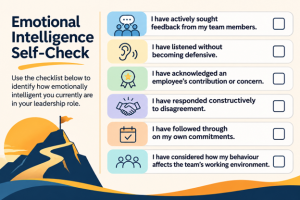
The manager’s action checklist