Leadership is often measured by the decisions leaders make, the results they deliver and the organisations they build. Yet its longer-term significance lies in whether those results can be sustained, whether institutions are strengthened and whether others are equipped to carry the work forward. This is as true of national economic development as it is of the communities and institutions that shape society.
These questions found expression at the 2026 Lagos Business School Alumni Association (LBSAA) Homecoming Weekend, held on 12 and 13 November. Over two days, alumni returned to Lagos Business School to exchange ideas, reconnect with classmates, welcome new leadership and reflect on the role the alumni community can play in shaping business, society and national development. The events alternated between serious conversations about Nigeria’s future and moments of celebration, but a common theme emerged: leadership is most meaningful when it creates impact that endures beyond any individual’s tenure.
From Potential to Execution: The Alumni Day Conference
Hosted by the OMP 40 class under the theme Driving Nigeria’s Economic Transformation Through Leadership, Capital and AI-Driven Innovation, Thursday’s Alumni Day Conference opened with a challenge central to Nigeria’s development ambitions: how can the country move beyond its considerable potential to deliver sustained economic progress?
Delivering the opening address, Professor Olayinka David-West, Dean of Lagos Business School, Pan-Atlantic University (LBS), highlighted the importance of ethical, decisive and future-ready leadership, purposeful investment in businesses, infrastructure and people, and the application of technology to reimagine critical sectors of the economy. She also invited alumni to continue to bring their time, talent, and networks closer to the School’s mission.
The economic session led by Professor Bongo Adi offered an unvarnished assessment of the environment facing businesses and households, exploring the tension between encouraging market indicators and the continuing pressures created by inflation, borrowing costs, exchange-rate stability and consumer confidence. His analysis highlighted the difficult balancing act confronting business leaders and investors. According to him, economic transformation is not simply about optimism. It requires organisations that can navigate uncertainty, adapt to changing conditions and make informed decisions about where and how capital should be deployed.
The focus on execution was reinforced by the keynote speaker Mr Chris Oshiafi, Group CEO of PanAfrican Capital Holdings Limited. While acknowledging the importance of strategy, he emphasised a truth familiar to many business leaders: good ideas alone do not create value. Progress depends on execution. It requires leaders capable of directing capital towards productive activities and applying technologies such as artificial intelligence to solve real problems, improve productivity and unlock new opportunities.
Taken together, the discussions pointed to a broader conclusion. Nigeria’s prosperity depends on execution: deploying capital effectively, building resilient institutions and ensuring that innovation translates into tangible economic and social progress. For a country with Nigeria’s development ambitions, the challenge is to convert resources into measurable improvements in productivity, competitiveness and living standards.
For the LBS alumni community, this message carried particular significance. Across industries and sectors, alumni occupy positions from which they can influence investment decisions, organisational strategy, innovation and public policy. For a room filled with executives shaping policy, finance, and enterprise across the country, the takeaway was clear: insight without collective action leaves value on the table.
Continuity, Camaraderie, and a Chair for a Founding Dean
Where Thursday’s conversations focused on leadership’s role in shaping the future, Friday evening turned the attention to another dimension of leadership: the responsibility to sustain institutions and communities over time.
The President’s Dinner brought together generations of LBS alumni in a setting filled with warmth, celebration and renewed connection. Former classmates reunited, new relationships were formed, and conversations flowed. There was music, laughter and a shared appreciation for the community that continues to connect alumni long after graduation.
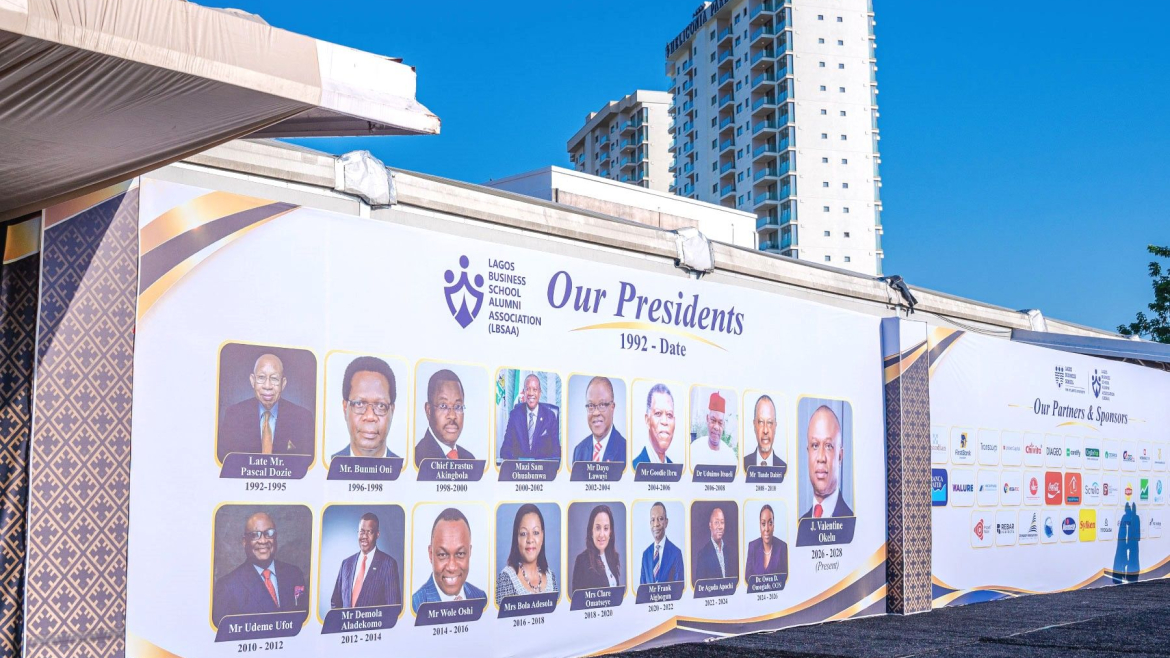
The evening also marked the formal leadership handover from outgoing LBSAA President, Dr Owen Omogiafo, OON, to incoming President, Pharm. Valentine Okelu and his Executive Council, including Wole Abu as Vice-President and Cynthia Muoneke as Council Secretary. Watching alongside them were several past LBSAA Presidents, including Sir Demola Aladekomo, Udeme Ufot, and Clare Omatseye. The ceremony was a testament to an enduring institution built season by season across successive generations.
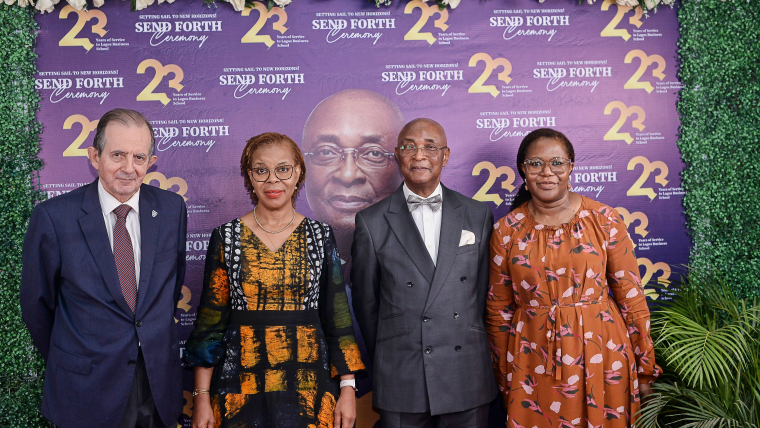
Reflecting on that continuity, Professor David-West noted that leadership is ultimately measured not by titles held, but by the people, teams, and communities built. That truth came into sharp, emotional focus during a tribute to the late founding dean, Professor Albert Alos, as the incoming Executive Council announced its commitment to funding a Professorial Chair in his honour, turning institutional memory into permanent academic impact.
Cohort pride also had its moment. OMP 40 capped off their conference hosting duties by clinching first place in the annual class awards for the second consecutive year, ahead of AMP 22 and EMBA 19, sparking the kind of spirited applause that defines LBS class culture.
10,000 Leaders, One Shared Responsibility
With a community now exceeding 10,000 alumni, incoming President Pharm. Valentine Okelu closed with a clear challenge: the true measure of the LBSAA is not the size of its directory, but how actively members use their collective influence to open doors for one another and shape corporate Nigeria.
Leadership creates possibilities. Communities turn them into reality. At the 2026 Homecoming Weekend, the LBS community showed the transformation that happens when both meet in the same room.