
Across Africa, multinational organisations continue to invest in developing local talent and building leadership capacity. Yet an important question remains in some sectors: what factors shape access to senior leadership opportunities, and who ultimately reaches the highest levels of organisational leadership?
As more professionals gain world-class education, global experience, and industry expertise, understanding the factors that influence leadership appointments has become increasingly important. Why do some sectors continue to struggle with local representation at senior leadership levels, despite growing pools of qualified talent?
The answer is more complex than a simple question of qualifications.
Behind leadership appointments often lies a web of perceptions, experiences, relationships, and institutional dynamics that shape who is seen as leadership material and who ultimately gains access to decision-making roles.
A recently published study, The Lack of Locals in Senior Leadership Positions in Africa’s Multinational Hotel Industry: A Bourdieusian Theory Perspective, explores this challenge through the lens of Sub-Saharan Africa’s multinational hotel industry. While the research is grounded in hospitality, its insights resonate far beyond a single sector. The findings point to broader questions facing multinational organisations across emerging markets: How are leadership decisions made? What experiences are valued most? And what factors continue to influence who advances to the highest levels of organisations?
Looking Beyond the Leadership Pipeline
Conversations about local leadership representation often focus on talent pipelines. The assumption is that if organisations develop enough qualified local professionals, leadership diversity will naturally follow.
The research suggests the reality is more nuanced.
Rather than identifying a single barrier, the study highlights three interconnected dynamics shaping access to senior leadership positions:
The first is organisational mindsets about local talent. The perceptions held by property owners, brand owners, and decision-makers can significantly influence leadership appointments and succession decisions.
The second is global exposure. International experience is frequently viewed as a prerequisite for senior leadership, creating additional hurdles for professionals whose career paths may not provide the same opportunities for international mobility.
The third relates to competencies that extend beyond technical expertise. Access to leadership opportunities is often influenced by professional networks, institutional relationships, and forms of social capital that can be difficult to build without intentional organisational support.
Together, these factors help explain why leadership representation often remains uneven despite a growing pool of capable local professionals.
A Conversation for Business Leaders
The implications extend well beyond hospitality.
Across industries, organisations are grappling with questions around localisation, succession planning, leadership development, and the long-term sustainability of their talent strategies.
For executives, these questions have direct business relevance. Organisations that fail to cultivate strong local leadership pipelines may limit their ability to fully leverage market knowledge, build stakeholder trust, and create resilient leadership succession plans.
For HR and talent management professionals, the research offers a practical framework for identifying where barriers may exist and where interventions can be most effective.
For policymakers and development stakeholders, it provides evidence that can inform broader conversations around economic participation, talent development, and leadership representation.
And for ambitious professionals seeking to advance into senior leadership roles, it sheds light on some of the less visible dynamics that influence career progression within multinational organisations.
From Research to Action
Understanding the barriers is only the beginning. The more important question is what organisations can do differently.
How can multinational companies create more intentional pathways to leadership for local professionals? What role should global exposure play in leadership development? How can organisations rethink the competencies they value when making leadership appointments? And how can they build systems that expand access to the networks and relationships that often shape career advancement?
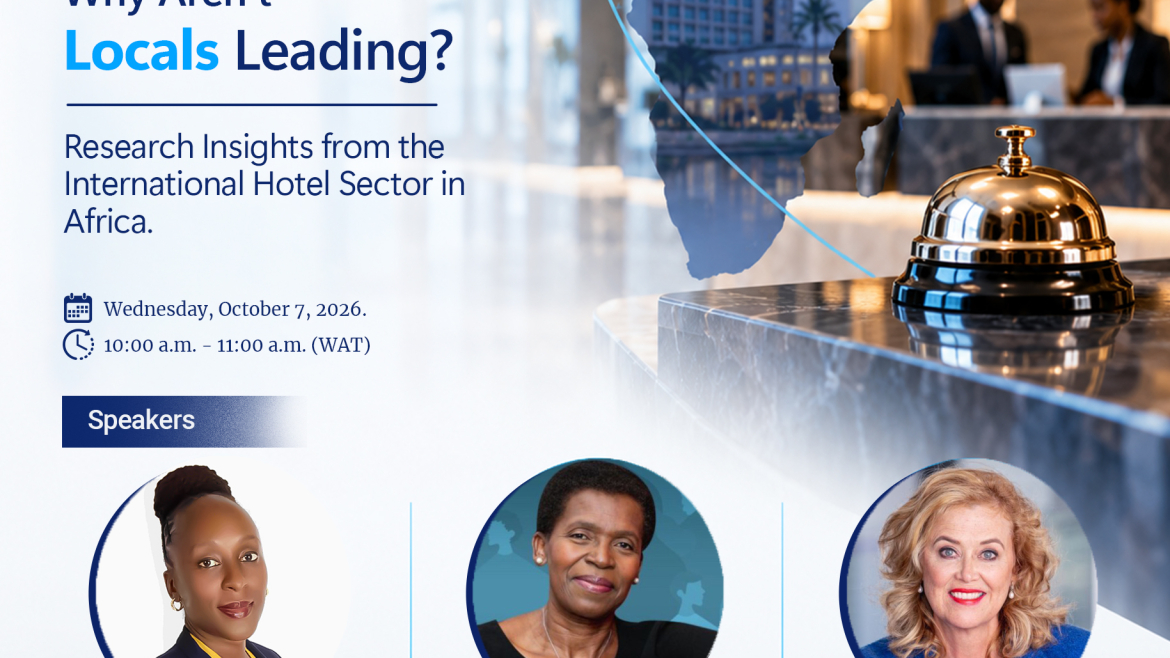
These are some of the critical questions that will be explored during an upcoming webinar based on the study.
Bringing together research and practice, the session will unpack the findings, challenge assumptions, and provide a practical framework for understanding the structural and perceptual factors influencing local leadership representation.
For leaders committed to building stronger organisations and more inclusive leadership pathways, it promises to be an important conversation.
Register for the Webinar
Join us on 7 October 2026 as we explore the findings of The Lack of Locals in Senior Leadership Positions in Africa’s Multinational Hotel Industry: A Bourdieusian Theory Perspective and discuss their implications for leaders, HR professionals, policymakers, and talent development practitioners.
Date: 7 October 2026
Time: 10:00 AM WAT
Location: Virtual
Register here: events.lbs.edu.ng/HospitalityResearch